The Anatomy of a High-Conversion Sales Conversation: A Step-by-Step Guide to Mastery
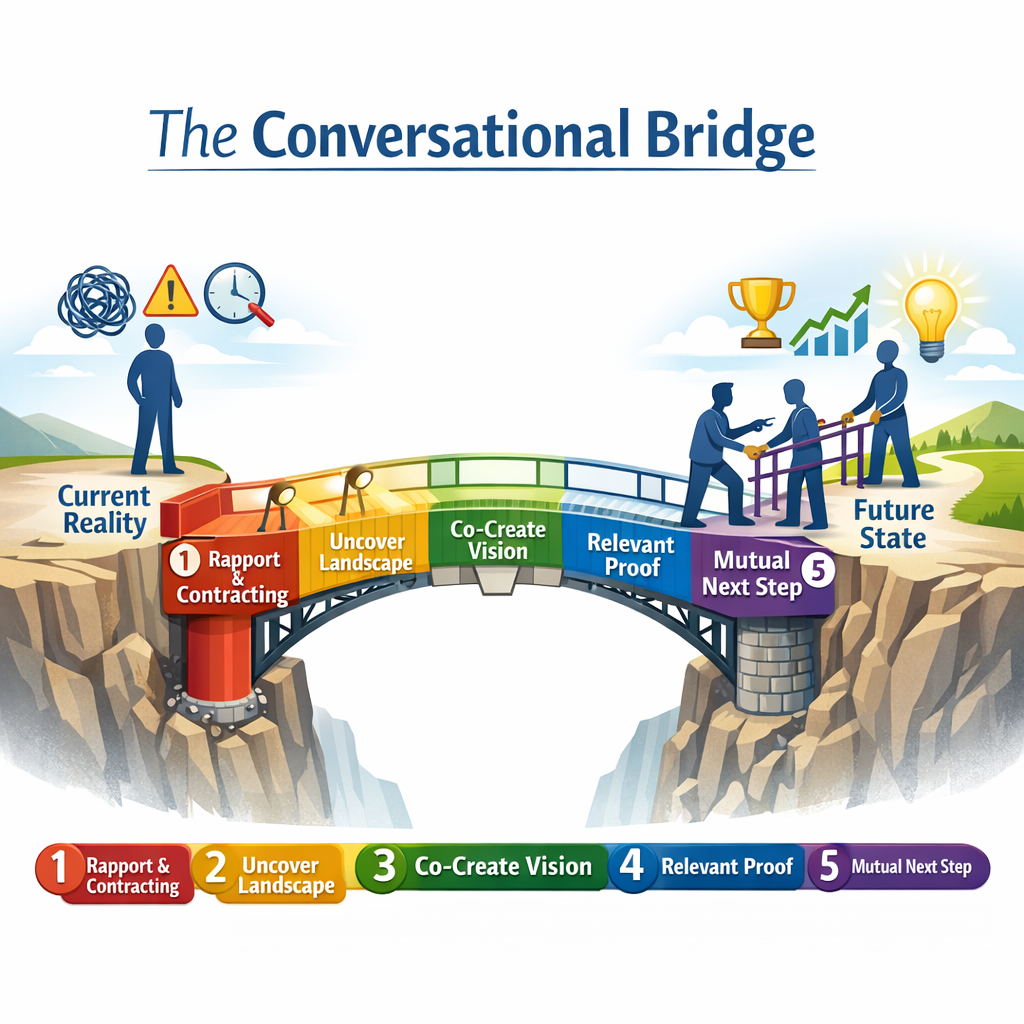
The difference between a good salesperson and a great one is not found in their product knowledge or their prospecting strategy. It is found in the quality of their conversations. In a world saturated with digital noise and automated outreach, the human conversation remains the single most powerful tool in the sales professional's arsenal. Yet, too many of these critical interactions are left to chance, governed by habit rather than design. A high-conversion sales conversation is not a casual chat. It is a carefully orchestrated exchange, a strategic dance with a clear architecture. It is a collaborative journey where the seller acts not as a presenter, but as a guide, leading the prospect from a state of latent need to a vision of a tangible solution. For the small team where every opportunity must count, mastering this anatomy is not an advanced skill; it is a fundamental necessity. This article deconstructs the high-conversion conversation into its essential phases, providing a step-by-step framework that transforms dialogue into results.
Think of the last sales call that failed to progress. It likely felt pleasant but aimless, or perhaps it was a feature-heavy monologue that left the prospect politely disengaged. The problem often lies in a misalignment of purpose. The seller is focused on telling, while the buyer is seeking to understand. The high-conversion conversation corrects this by making the buyer's discovery process its central focus. It is built on a simple but profound premise: people do not buy products; they buy better versions of their own future. Your role is to help them construct that future, piece by collaborative piece, within the conversation itself. The following framework provides the blueprint.
Phase 1: The Foundation - Rapport and Contracting (First 5-7 Minutes)
The opening minutes set the psychological tone for the entire interaction. This phase is not about small talk; it is about establishing safety, clarity, and mutual intent.
The Rapport Bridge: Begin with genuine, focused acknowledgment. Thank them for their time. Make a specific, positive observation that shows you have done your homework. "I appreciated the article you shared on LinkedIn about remote team culture, it resonated with some challenges we see often." This demonstrates respect and immediately differentiates you from generic outreach. The goal is to build a bridge of human connection, signaling that this is a conversation between professionals, not a pitch to a target.
Setting the Collaborative Contract: This is the most critical and often skipped step. Clearly and succinctly state the purpose of the call and what a successful outcome looks like for both parties. For example: "What I’d like to do today is to understand your key priorities around [their stated goal or challenge] and explore whether what we do could be a potential fit. By the end of our time, my goal is that we both have absolute clarity on if and how it makes sense to take a next step. How does that sound?" This does three things. First, it establishes you as an organized professional. Second, it gives the prospect psychological safety—they know the agenda and can relax into the conversation. Third, it frames the call as a mutual exploration, not a sales pitch. Their agreement to this contract is your first and most important "yes."
Phase 2: The Discovery Engine - Uncovering the Real Landscape (Minutes 7-25)
This is the core of the conversation. Its purpose is not to gather information to slot into your product's features. Its purpose is to help the prospect articulate and feel the full dimensions of their current situation, their desired future, and the cost of the gap between them.
Employing the Three-Tier Questioning Framework: Move logically from broad context to specific, emotional impact.
- Landscape Questions: Start wide. "Can you help me understand the broader goals for your department this year?" or "What initiated the search for a solution like this?" This establishes the strategic backdrop.
- Process & Pain Questions: Drill into the current workflow. "Walk me through how your team currently handles [specific process]." Then, probe for the friction. "Where does that process tend to break down or create the most headaches?" "What's the impact when that happens?" Listen for verbs and nouns—the specific actions and tools that are causing strain.
- Impact & Motivation Questions: This is where you uncover the real driver. Move from the operational symptom to the personal and business consequence. "When that breakdown happens, what does it cost you in terms of time, revenue, or team morale?" "If you could solve this perfectly, what would that allow you or your team to achieve that you can't right now?" The goal here is to get the prospect to articulate the cost of inaction and the value of a solution in their own words. You are helping them build a business case for change, out loud.
Practicing Active, Diagnostic Listening: Your job here is not to wait for your turn to talk. It is to listen like a doctor diagnosing an ailment. Use summarizing to confirm understanding. "So, if I hear you correctly, the manual reporting is taking about 15 hours a week from your analysts, which delays strategic decisions and frustrates the team because they feel their skills are underutilized. Is that accurate?" This deep validation makes the prospect feel profoundly heard and solidifies the problem's importance.
Phase 3: The Strategic Shift - From Problem to Vision (Minutes 25-35)
You have thoroughly mapped the current reality. Now, you must pivot the conversation to the future. Do not jump to your product. First, co-create the vision of success.
The Future-State Framing: Ask a visionary question. "Let's imagine it's six months from now and this problem has been completely solved. What does that look like? What are you and your team able to do that you can't today?" Guide them to describe tangible outcomes: faster delivery times, higher customer satisfaction scores, reclaimed hours for strategic work.
Introducing Your World as a Bridge: Only after they have painted the picture of the desired future do you introduce your solution. Frame it not as a product, but as a methodology or a set of principles that bridges their current state to their future state. "Based on what you've described—the need for real-time visibility and to free up your analysts' time—our approach is fundamentally centered on automated data aggregation and customizable dashboards. The core idea is to..." You are now connecting your capabilities directly to the landscape they just defined.
Phase 4: The Focused Demonstration - Relevance Over Features (Minutes 35-45)
If a demo is appropriate, it must be a focused surgical strike, not a grand tour.
The "Show Don't Tell" Rule: Do not narrate your menu of features. Revisit a specific pain point they shared. "You mentioned the frustration of manually pulling data from three systems. Let me show you what that unified view looks like in our platform, and how you could generate that report in one click." Demonstrate the exact capability that solves their articulated problem. Then, stop. Ask, "Is this what you had in mind for solving that challenge?" This turns the demo from a presentation into a validation session. You are showing them their future, not your software.
Phase 5: The Collaborative Close - Determining Mutual Fit (Final 5-10 Minutes)
A high-conversion conversation does not end with a "hard close." It ends with a collaborative assessment of next steps based on mutual fit.
The Summary & Value Playback: Synthesize the conversation brilliantly. "Let me make sure I've captured everything. You're looking to solve for A, B, and C, with the key goal of achieving X. What we've looked at today suggests our approach could help by doing Y and Z, which would address those core needs. Does that align with your understanding?" This is your final and most powerful alignment check.
The Natural Next Step: Based on the conversation's depth and their engagement, propose a logical, low-friction next step that continues the collaboration. "Given the complexity we've discussed, I suggest two potential paths forward. One, we could set up a more technical deep-dive with your analyst team on the data workflow. Or two, I could put together a brief one-page summary of what we discussed today, including the potential ROI based on the 15-hour savings you mentioned, for you to share internally. Which of those feels more useful as a next step?" This approach assumes the forward motion, gives them a choice, and ties the next step directly to the value they identified.
The Master's Mindset: The Principles Behind the Steps
Executing this anatomy requires more than memorizing steps. It requires an underlying mindset.
Be a Student, Not a Sage: Enter every conversation with genuine curiosity. Your goal is to learn their world, not to prove you know yours.
Prioritize Depth Over Speed: Resist the urge to rush to your pitch. The more thoroughly you explore the problem, the more valuable your solution becomes. A conversation that uncovers a profound, shared understanding of a painful problem will almost always earn a next step.
Silence is Your Tool: After asking a powerful question, be comfortable with silence. Allow the prospect the space to think and articulate. The most valuable insights often come after a pause.
For the small team operating in a competitive landscape, this conversational mastery is your ultimate leverage. It turns your limited number of touches into disproportionately powerful engagements. It builds trust at speed and creates clarity where there was ambiguity. By adopting this anatomical framework, you move from having sales calls to facilitating buying conversations. You stop chasing clients and start attracting partners, one masterful dialogue at a time.


