The Intelligence Paradigm: Building Companies That Think
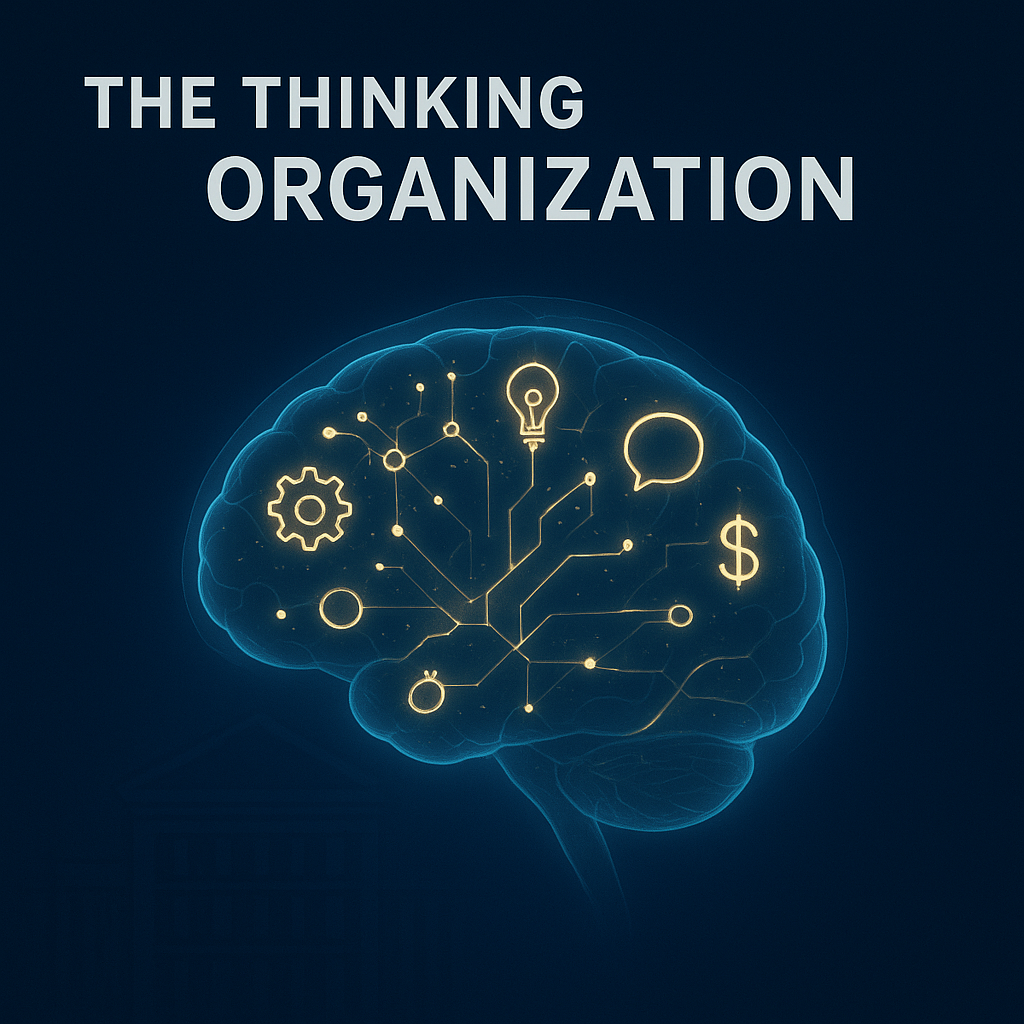
In the quiet, air conditioned rooms where the world's most advanced AI models train, a revolution is brewing that will redefine the very nature of competition. We are witnessing the emergence of a new kind of company. This company does not just use artificial intelligence but operates as an intelligent system itself. This represents a fundamental shift from organizations that deploy technology to organizations that embody intelligence as their core operating principle. We are moving beyond the era of the digital company into the age of the cognitive enterprise.
For decades, the dominant paradigm has been automation. This meant using technology to perform tasks humans previously did. This was followed by augmentation, using technology to enhance human capabilities. Now we are entering a third paradigm: cognition. This is the process of building companies that can perceive, reason, learn, and make decisions as integrated systems. The most forward thinking organizations are not just implementing AI tools. They are architecting themselves as intelligent entities capable of continuous learning and adaptation at scale.
The implications of this shift are profound. Traditional companies compete on resources, talent, and market position. Cognitive enterprises compete on learning velocity, adaptive capacity, and decision intelligence. While most businesses are still optimizing for efficiency, the leaders are designing organizations that can think, learn, and evolve faster than their competitors can adapt.
The Architecture of Cognition
Building a cognitive enterprise requires a fundamentally different architectural approach than traditional organizational design. It involves creating systems that enable the organization to learn collectively, reason systematically, and act intelligently as a unified entity.
The Perceptual Layer: The Organization's Nervous System
Every intelligent system begins with perception. This is the ability to understand its environment. For organizations, this means developing what might be called an organizational nervous system. This is a comprehensive network of sensors and data streams that provides real time understanding of both internal operations and external environment.
Traditional business intelligence systems are like cameras that take periodic snapshots. An organizational nervous system is more like a living sensory system. It continuously monitors, processes, and understands multiple streams of information simultaneously. This includes not just structured data from internal systems but unstructured data from customer interactions, market signals, competitive movements, and even broader social and economic trends.
The most sophisticated implementations employ what cognitive scientists call multi modal perception. They combine different types of data, including numerical, textual, visual, and auditory information, to form a rich, multi dimensional understanding of their environment. A retail company's perceptual system, for example, might combine sales data with social media sentiment, weather patterns, local events calendars, and even foot traffic patterns from satellite imagery. The goal is to understand not just what is happening in their market, but why it is happening and what might happen next.
The Reasoning Layer: The Organization's Cognitive Engine
Perception alone is not enough. Intelligence requires the ability to reason. This means processing information, drawing inferences, and making judgments. In a cognitive enterprise, this happens at what we might call the organizational reasoning layer.
This layer operates differently from traditional decision making systems. Traditional systems typically rely on human managers to interpret data and make decisions. Cognitive systems employ what artificial intelligence researchers call multi agent reasoning. This involves multiple specialized AI systems working in concert to analyze situations, evaluate options, and recommend actions.
A financial institution's reasoning layer, for instance, might include specialized agents for risk assessment, regulatory compliance, customer behavior prediction, and market trend analysis. These agents do not work in isolation. They collaborate, sharing insights and challenging each other's assumptions. When evaluating a loan application, the system might consider not just the applicant's credit score but patterns in their financial behavior, broader economic trends, and even the performance of similar loans in similar conditions.
What makes this reasoning truly intelligent is its ability to handle complexity and uncertainty. Traditional systems often struggle with situations that do not fit predefined categories or rules. Cognitive systems excel in these situations. They use probabilistic reasoning, pattern recognition, and even what might be called organizational intuition. This is the accumulated wisdom of thousands of previous decisions and outcomes.
The Learning Layer: The Organization's Memory and Adaptation System
Perhaps the most distinctive feature of cognitive enterprises is their ability to learn systematically and continuously. Every action, every decision, every outcome becomes input for organizational learning. This creates what learning scientists call a virtuous cycle of improvement. Better decisions lead to better outcomes, which provide better data for learning, which leads to even better decisions.
The learning layer operates at multiple levels. At the operational level, it learns from daily activities. This includes which marketing messages resonate, which sales approaches work, and which operational processes are most efficient. At the strategic level, it learns from larger patterns. This includes how market conditions affect different business units, how competitive moves impact market position, and how economic cycles influence customer behavior.
Most importantly, the learning layer enables what organizational theorists call meta learning. This is the ability to learn how to learn more effectively. The system does not just accumulate knowledge. It improves its processes for acquiring, storing, and applying knowledge. It learns which types of information are most valuable in which contexts, which analytical approaches yield the best insights, and which decision making frameworks produce the best outcomes.
The Human Cognitive Partnership
The rise of cognitive enterprises does not mean the end of human involvement in business. On the contrary, it represents a new and more sophisticated form of partnership between human and machine intelligence.
The New Division of Cognitive Labor
In cognitive enterprises, the division of labor follows a clear principle. Each does what it does best. AI systems handle tasks that require scale, speed, pattern recognition, and data processing. Humans handle tasks that require creativity, empathy, ethical judgment, and contextual understanding.
This division is not rigid but fluid and complementary. In a product development process, for instance, AI systems might analyze user data to identify unmet needs and opportunities, generate dozens of potential product concepts, and even simulate how different features might perform in the market. Human product managers and designers would then apply their creative vision, aesthetic judgment, and understanding of human psychology to refine these concepts. They add the elements of beauty, meaning, and emotional resonance that machines cannot yet replicate.
The Human Role as Sense Maker and Strategist
As AI systems take on more operational and analytical functions, the human role evolves toward what might be called sense making and strategic direction. Humans become the interpreters of meaning, the arbiters of values, and the architects of purpose.
In a cognitive marketing department, for example, AI systems might handle campaign execution, performance optimization, and even content generation. Human marketers would focus on understanding cultural trends, defining brand meaning, and crafting the overarching narrative that gives coherence to all marketing activities. They would be less concerned with the mechanics of marketing and more concerned with its meaning and impact.
Building Cognitive Literacy
For this partnership to work effectively, organizations need to develop what might be called cognitive literacy. This is the ability of human employees to understand, interact with, and leverage cognitive systems. This goes beyond technical skills to include a deeper understanding of how these systems think, their capabilities and limitations, and how to collaborate with them effectively.
Cognitive literate professionals understand how to frame problems in ways that AI systems can address, how to interpret and question AI generated insights, and how to combine machine intelligence with human judgment to make better decisions. They are comfortable working alongside systems that can process more data and analyze more variables than any human could. They also understand when and how to apply human wisdom that transcends data and algorithms.
The Strategic Advantages of Cognition
Companies that successfully transition to cognitive operations gain several distinct competitive advantages that are difficult for traditional organizations to match.
Velocity of Learning and Adaptation
Perhaps the most significant advantage is learning velocity. This is the speed at which an organization can learn from experience and adapt its behavior. Traditional organizations often learn slowly, with knowledge trapped in individual heads or departmental silos. Cognitive enterprises learn continuously and systematically, with insights flowing immediately to where they are needed.
This creates organizations that can adapt to changing conditions with remarkable speed. When market conditions shift or new opportunities emerge, cognitive enterprises do not need lengthy analysis and debate. Their systems have already detected the changes, analyzed their implications, and begun adapting operations accordingly.
Decision Quality at Scale
Cognitive enterprises make better decisions, and they make them consistently at scale. Traditional organizations often suffer from decision inconsistency. Different managers make different decisions in similar situations based on their individual experience and judgment. Cognitive systems apply the same analytical frameworks and decision criteria consistently across the organization.
This does not mean every decision is perfect. It does mean decisions are systematically informed by the best available data and analysis. Over time, as the system learns from outcomes, decision quality improves continuously across the entire organization.
Resource Optimization Through Intelligence
Cognitive enterprises use resources more intelligently. These resources include time, money, and talent. Their systems continuously monitor resource allocation and performance, identifying opportunities to reallocate resources from lower value to higher value activities.
This creates organizations that are not just efficient in the traditional sense of doing things right, but effective in the deeper sense of doing the right things. They do not just optimize existing processes. They continuously redesign processes and reallocate resources based on what creates the most value.
The Implementation Journey
Transitioning to a cognitive enterprise is not a single project but a multi year journey of organizational transformation. Successful implementations typically follow a progression from experimental initiatives to systemic transformation.
The journey often begins with what might be called cognitive pilots. These are targeted initiatives in specific areas where AI can deliver clear value. These might include cognitive customer service systems, intelligent supply chain optimization, or AI powered marketing personalization. These pilots serve both to demonstrate value and to build organizational capability and confidence.
As organizations gain experience, they move to what might be called cognitive platforms. These are integrated systems that provide cognitive capabilities across multiple functions. These platforms typically include shared data infrastructure, common AI tools and frameworks, and standardized approaches to human AI collaboration.
The most mature organizations evolve into what might be called cognitive ecosystems. These are fully integrated environments where intelligence flows seamlessly across traditional boundaries, supporting continuous learning and adaptation at the organizational level.
The Future of Cognitive Competition
Looking forward, we can expect to see several important developments in how organizations leverage cognitive capabilities.
We are likely to see the emergence of what might be called collective cognition. These are systems that enable not just individual organizations but entire networks of partners, suppliers, and customers to learn and adapt together. This could enable new forms of collaboration and value creation that transcend traditional organizational boundaries.
We may also see advances in what might be called explainable cognition. These are systems that can not only make intelligent decisions but explain their reasoning in ways that humans can understand, trust, and learn from. This will be crucial for building the transparency and accountability needed for widespread adoption.
Perhaps most importantly, we may see the development of what might be called ethical cognition. These are systems designed not just to optimize for efficiency or profit but to align with human values, respect individual dignity, and contribute to broader social good. This represents perhaps the greatest challenge and opportunity of the cognitive revolution.
Conclusion
The transition to cognitive enterprise represents more than just another technological trend. It represents a fundamental reimagining of what organizations are and how they operate. We are moving from organizations as collections of processes to organizations as integrated cognitive systems.
This shift brings tremendous opportunities for those who embrace it early and thoughtfully. Cognitive enterprises will be able to learn faster, adapt more quickly, make better decisions, and create more value than their traditional competitors. They will be better equipped to navigate an increasingly complex and uncertain world.
But the transition also brings significant challenges. It requires rethinking everything from organizational structure to leadership philosophy to individual roles and skills. It demands careful attention to ethical considerations and human values. And it requires a willingness to question assumptions that have guided business for generations.
The organizations that will thrive in the coming decades will not be those with the most resources or the best traditional strategies. They will be those that have learned to think. They will perceive their environment clearly, reason about it intelligently, learn from it continuously, and act on that learning effectively. They will be, in the truest sense, cognitive enterprises.


