The Intelligence Revolution: Moving Beyond Automation to Strategic AI Orchestration
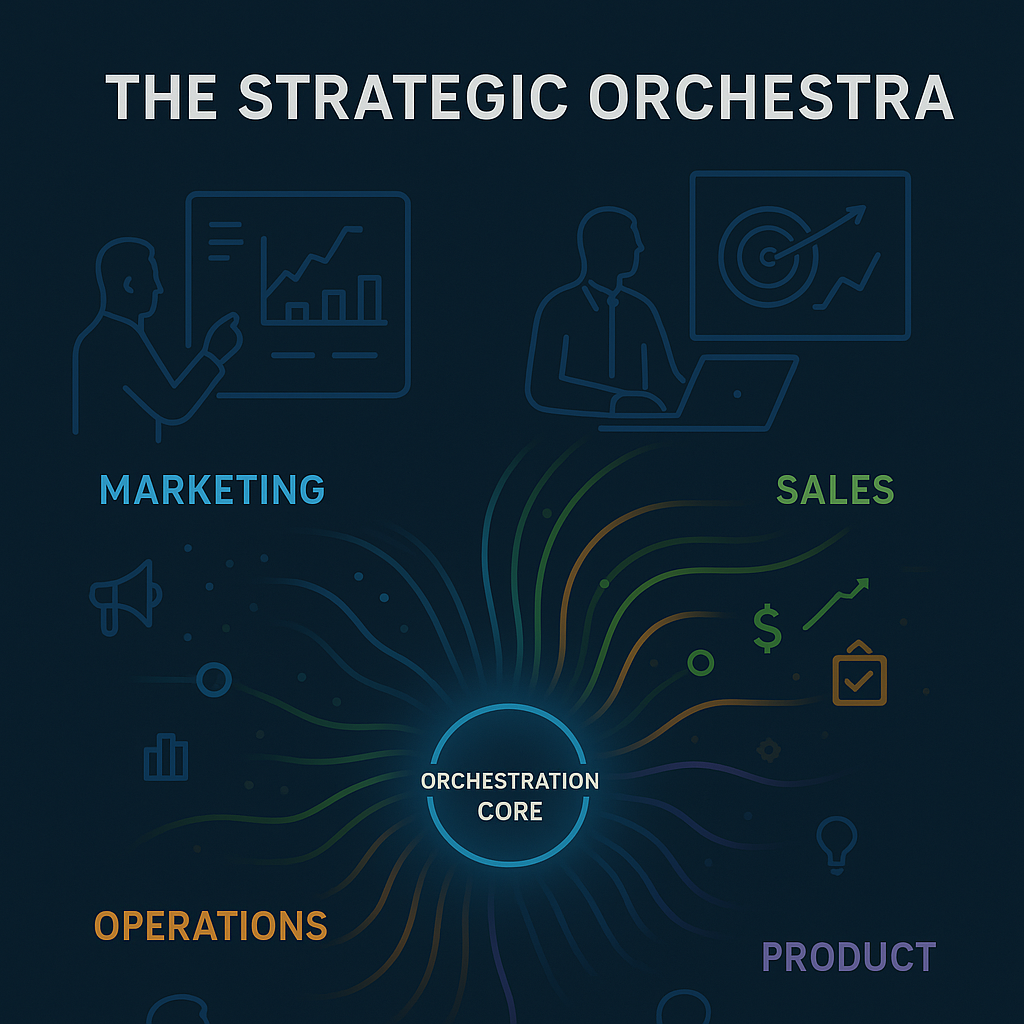
We are witnessing a fundamental shift in how businesses leverage artificial intelligence, a transition so profound it represents nothing less than a revolution in organizational intelligence. The first wave of business AI focused on task automation, replacing human effort in repetitive processes. The second wave concentrated on augmentation, enhancing human capabilities with intelligent tools. Now, we are entering the third wave: strategic orchestration, where AI systems do not just perform tasks or assist humans, but actively coordinate complex business processes, make strategic decisions, and drive organizational outcomes with minimal human intervention.
This revolution represents a paradigm shift from AI as a productivity tool to AI as a strategic partner. Companies that master this transition are not just automating processes. They are building what might be called intelligent enterprises, organizations where AI systems serve as the connective tissue between strategy and execution, between data and action, between human insight and machine scale implementation.
The implications are staggering. While most businesses are still experimenting with chatbots and content generators, forward thinking organizations are deploying AI systems that manage entire business functions, from customer acquisition to supply chain optimization to product development. These systems are not merely executing predefined workflows. They are learning, adapting, and making increasingly sophisticated decisions that directly impact business outcomes.
The Three Layers of Strategic AI Orchestration
Understanding strategic AI orchestration requires moving beyond the tool centric thinking that dominates most AI conversations. This new paradigm operates across three interconnected layers that transform how organizations function.
Layer One: The Intelligence Foundation
At the base of every intelligent enterprise lies what might be called the intelligence foundation. This is a comprehensive system for capturing, processing, and contextualizing organizational knowledge. This goes far beyond traditional data warehouses or business intelligence platforms.
The modern intelligence foundation incorporates multiple data modalities. It includes structured data from operational systems, unstructured data from communications and documents, behavioral data from user interactions, and external data from market signals and competitive intelligence. More importantly, it understands the relationships between these data points, creating what data architects call a knowledge graph of the organization and its environment.
This foundation possesses several critical characteristics. First, it operates in real time, processing information as it emerges rather than in periodic batches. Second, it maintains context, understanding how different pieces of information relate to each other and to organizational objectives. Third, it learns continuously, improving its understanding and capabilities with each new interaction and outcome.
A financial services company implementing this foundation, for example, might connect trading data with market news, regulatory updates, client communications, and even geopolitical events. The system would not just store this information. It would understand how these elements influence each other and affect investment decisions and risk exposure.
Layer Two: The Orchestration Engine
Building upon the intelligence foundation sits what might be called the orchestration engine. This is the system that translates strategic objectives into coordinated action across the organization. This represents the most significant departure from traditional automation systems.
Traditional automation follows predefined rules: if X happens, do Y. Orchestration engines operate differently. They are given objectives, such as increase customer retention by 15 percent, reduce time to market for new products by 30 percent, or improve supply chain efficiency by 25 percent. They then determine the optimal sequence of actions to achieve those objectives, adapting their approach based on real time feedback and changing conditions.
These engines coordinate across traditional organizational silos. A customer retention objective might involve orchestrating actions across marketing for personalized re engagement campaigns, product for feature improvements based on usage patterns, customer success for proactive outreach to at risk accounts, and even finance for loyalty incentives. The engine does not just execute these actions. It determines their timing, sequence, and resource allocation based on what is working.
Perhaps most importantly, orchestration engines learn from outcomes. They track which approaches achieve the best results in which contexts, continuously refining their strategies and decision making frameworks. Over time, they develop what might be called organizational wisdom, a deep understanding of what works for that specific organization in its specific context.
Layer Three: The Human Machine Interface
The third layer, and perhaps the most crucial for successful implementation, is the human machine interface. This is not just a dashboard or control panel. It is the complete system through which humans and AI systems collaborate.
In strategically orchestrated organizations, the division of labor between humans and machines follows a clear principle. Machines handle scale, speed, and pattern recognition. Humans handle judgment, creativity, and exception management. The interface ensures these capabilities complement rather than conflict with each other.
This interface has several critical functions. It provides transparency into how AI systems are making decisions and what outcomes they are achieving. It establishes governance mechanisms that ensure AI actions align with organizational values and ethical standards. Most importantly, it creates feedback loops where human expertise improves AI performance, and AI insights enhance human decision making.
In practice, this might mean a product manager setting strategic parameters for an AI system that then manages the entire product development lifecycle, from feature prioritization based on user data to sprint planning to release scheduling. The human focuses on strategic direction and handles exceptional cases, while the AI handles the complex coordination of dozens of interdependent processes.
The Strategic Impact: From Efficiency to Evolution
The shift from automation to orchestration transforms AI from a tactical tool to a strategic asset with profound implications for how businesses compete and create value.
Dynamic Strategy Execution
Traditional strategic planning operates on quarterly or annual cycles. Strategies are developed, resources are allocated, and execution begins, often with limited adjustment until the next planning cycle. In an orchestrated enterprise, strategy becomes dynamic and adaptive.
AI orchestration systems can translate high level objectives into executable actions while continuously monitoring performance and adjusting approaches based on what is working. If market conditions change or initial assumptions prove incorrect, the system can pivot strategy execution in real time, reallocating resources and adjusting tactics without waiting for human review and approval.
This creates organizations that are both more agile and more consistent in their execution. They can respond to opportunities and threats with unprecedented speed while maintaining alignment with long term objectives.
Emergent Innovation
Perhaps the most exciting potential of strategic orchestration lies in what might be called emergent innovation. This is the ability to identify and pursue opportunities that no human would have recognized through conventional analysis.
Orchestration systems, with their ability to process vast amounts of data and identify subtle patterns, can spot opportunities at the intersection of different trends, technologies, and market needs. They can then coordinate the diverse capabilities needed to pursue those opportunities, bringing together the right people, resources, and processes.
A consumer goods company might have an orchestration system that identifies an emerging trend in sustainable packaging by analyzing social media sentiment, regulatory developments, supplier innovations, and sales data across multiple product lines. The system could then coordinate research and development, supply chain, marketing, and compliance teams to develop and launch a new product line, adjusting the approach based on early market feedback.
Scalable Personalization
In customer facing functions, orchestration enables what might be called scalable personalization. This is the ability to deliver experiences tailored to individual customers at the scale of millions.
Traditional personalization efforts often operate in silos. Marketing personalizes messages, product teams personalize features, and service teams personalize support. Orchestration connects these efforts, creating cohesive customer journeys that adapt based on individual behavior, preferences, and context.
An e commerce platform with strategic orchestration might coordinate personalized product recommendations, tailored marketing communications, dynamic pricing, and customized support interactions. All these elements would work in concert to maximize customer lifetime value while ensuring a consistent brand experience.
Implementation Challenges and Solutions
Transitioning to strategic AI orchestration presents significant challenges that require thoughtful approaches.
Technical Integration
The technical challenge of integrating disparate systems and data sources cannot be underestimated. Successful implementations typically take what might be called an API first, platform eventually approach.
Rather than attempting a massive integration project, organizations start by connecting key systems through APIs, creating what amounts to a minimum viable integration. They then gradually expand connectivity, focusing first on high value connections that enable critical orchestration capabilities. Over time, these point to point integrations evolve into a unified platform, but starting with focused connections allows for quicker value realization and learning.
Organizational Change
Perhaps the greater challenge lies in organizational change. Strategic orchestration requires rethinking roles, processes, and even cultural norms around decision making and authority.
Successful organizations approach this change through what might be called guided evolution rather than revolutionary transformation. They start with limited orchestration in non critical areas, allowing teams to build comfort and competence with the new approach. They provide extensive training not just on how to use the new systems, but on how to work effectively within an orchestrated environment. Most importantly, they celebrate early successes and learn openly from failures, building organizational confidence in the new approach.
Ethical Governance
As AI systems take on more strategic roles, ethical governance becomes increasingly critical. Organizations need robust frameworks to ensure AI decisions align with values and ethical standards.
The most effective governance approaches combine technical controls with human oversight. Technical controls include transparency mechanisms that explain AI decisions, bias detection systems that identify potential discrimination, and audit trails that document system actions. Human oversight involves regular reviews by cross functional ethics committees, clear escalation paths for questionable decisions, and ongoing monitoring of system outcomes.
The Future of Strategic Orchestration
Looking forward, strategic AI orchestration is likely to evolve in several important directions.
We can expect to see the emergence of what might be called cross organizational orchestration. These are systems that coordinate not just within organizations but across ecosystems of partners, suppliers, and even customers. This could enable entirely new business models built on seamless collaboration across organizational boundaries.
We are also likely to see advances in what might be termed explainable orchestration. These are systems that can not only make complex decisions but explain their reasoning in terms that humans can understand and evaluate. This will be crucial for building trust and ensuring effective human oversight.
Perhaps most significantly, we may see the development of meta orchestration. These are systems that do not just orchestrate business processes but orchestrate the development and improvement of orchestration systems themselves. This would create organizations that are not just intelligent but continuously learning and evolving in their intelligence.
Conclusion
The transition from automation to strategic orchestration represents the maturation of AI as a business technology. We are moving beyond using AI to do things faster or cheaper, to using AI to do things smarter and better. We are shifting from AI as a tool that humans use to AI as a partner that humans collaborate with.
The organizations that master this transition will operate with a level of agility, intelligence, and effectiveness that their competitors cannot match. They will be able to execute strategy with precision, innovate continuously, and create value in ways that were previously impossible.
This is not just another technological trend. It is a fundamental reimagining of how organizations function in an increasingly complex and dynamic world. The intelligence revolution is not coming. It is already here. The question is no longer whether organizations will embrace strategic AI orchestration, but how quickly they can build the capabilities to thrive in this new reality.


