The Modern Sales Stack: Essential Tools for Scaling Your Small Team in 2025
In the relentless pursuit of growth, small sales teams operate on a razor's edge. Every hour counts, every lead is precious, and every tool must justify its place in the workflow. Yet, the paradox of modern selling is that more tools do not necessarily mean better results. Disconnected point solutions create data silos, increase cognitive load, and often automate one task only to create manual work in another. For the small team, the strategic assembly of a modern, integrated sales stack is not an IT project it is the foundational blueprint for scalable, efficient, and predictable revenue growth.
The year 2025 marks a significant evolution from the era of the connected platform to the age of the autonomous, predictive revenue engine. According to a 2024 Gartner study, organizations using highly integrated, AI native sales technology stacks now achieve 35% higher revenue growth and 40% higher sales rep productivity than those with fragmented systems. For the small team, this integration and intelligence is no longer a force multiplier it is the baseline requirement for survival and the critical lever for outsized success.
The 2025 Paradigm: Predictive Integration and Autonomous Workflows
The first principle of building a modern sales stack for a small team in 2025 is to prioritize predictive, context aware integration over simple data syncing. A modern stack is a self optimizing system where AI does not just move data between apps, but analyzes that interconnected data to predict outcomes, prescribe next best actions, and execute autonomous workflows with human oversight.
The penalty for a disjointed stack is now existential for lean teams. Research by Salesforce indicates that reps in non integrated environments waste over 20% of their time on manual reconciliation and tool switching. For a five person team, that equates to a full time equivalent lost to administrative friction. The 2025 stack eliminates this by making the "single source of truth" intelligent and proactive, predicting what you need before you ask and surfacing it within your natural workflow.
The 2025 Essential Stack: An Intelligent, Layered Ecosystem
A scalable stack is built in interdependent, intelligent layers. Think of it as a smart home: a robust foundation powers everything, sensors (intelligence layer) monitor the environment, automated systems (execution layer) carry out tasks, and a central dashboard (insight layer) provides control and foresight. Each component communicates seamlessly to create a cohesive, responsive environment.
Layer 1: The AI Native Foundation Your CRM
Your CRM in 2025 is the predictive brain, not just the system of record. The choice hinges on which platform has the most advanced, built in AI that can learn from your unique data and processes.
Key 2025 Mandates:
- Predictive AI Core: Choose a CRM with an embedded AI that goes beyond dashboards to actively predict deal risks, suggest next steps, and forecast outcomes with high accuracy based on your historical data.
- Autonomous Workflow Engine: Look for platforms where you can build "if-then" automations that are triggered not just by data changes, but by AI predictions (e.g., "If AI predicts a 15% drop in win probability, then reassign deal and notify manager").
- Seamless Ecosystem: The CRM must be the central hub with pre built, deep integrations (often through partners like Zapier or Workato) to the specialized tools in other layers, allowing AI to analyze cross platform data.
- 2025 Frontrunners for Small Teams: HubSpot Sales Hub with its expanding AI features, Pipedrive with its new AI sales assistant and predictive forecasting, and Freshsales (Freshworks) with its integrated Freddy AI. These platforms are competing aggressively on built in intelligence for SMBs.
Layer 2: The Proactive Intelligence Layer AI & Data
This layer proactively finds, enriches, and interprets signals, serving as the sensory and analytical cortex of your operation.
A. Predictive Prospecting & Intent Platforms
The game in 2025 is predictive account based selling. These platforms use combined firmographic, technographic, and real time behavioral intent data to build dynamic "target account lists" that rank companies not just on fit, but on their predicted buying stage.
- 2025 Integration: These platforms feed a predictive "buying readiness score" directly into CRM contact and account records, triggering hyper personalized, stage specific outreach sequences automatically.
B. Generative Conversation Intelligence
Conversation AI has evolved from descriptive ("what happened") to prescriptive and generative ("what to do next" and "create content from this"). Modern platforms analyze calls and:
- Automatically generate follow up emails, summarizing key points and action items.
- Create tailored battle cards when a competitor is mentioned.
- Prescribe specific coaching exercises for reps based on deviation from top performer call patterns.
- Integration Point: These rich insights and auto generated assets are attached to CRM records, and key risk/opportunity flags can trigger automated coaching or management workflows.
Layer 3: The Autonomous Execution Layer Communication & Outreach
This layer encompasses tools that execute personalized engagement with a high degree of autonomy, guided by the intelligence layer.
A. AI Orchestration Platforms
Beyond multichannel cadences, 2025's tools use generative AI to create entire, dynamic engagement strategies. You input a goal ("Book a meeting with VP of Engineering at target accounts"), and the AI researches the accounts, crafts personalized messaging variants for different channels, schedules sends, and iterates based on engagement metrics.
- 2025 Feature: Cross Channel Narrative Consistency. The AI ensures the story told on LinkedIn, email, and voicemail is consistent and builds logically, treating the omnichannel journey as a single narrative.
B. Intelligent Comms Platform
The business phone system is now an AI co-pilot. These platforms offer real time voice analytics, post call summaries created by AI, and even "voice scoring" that analyzes tonality and pace to suggest adjustments for building better rapport.
- Integration Point: AI generated call summaries and key moments are logged to the CRM. Missed call handling can involve an AI assistant texting the caller to qualify intent and schedule a call back.
Layer 4: The Augmented Productivity Layer Workflow & Enablement
These tools use AI to radically compress the sales cycle and remove administrative blocks.
A. AI Powered Document & Proposal Automation
Proposal tools now use AI to pull data from the CRM and previous communications to auto generate first drafts of proposals, SOWs, and contracts. They also provide predictive analytics: "Based on similar deals, including section X increases close probability by 22%."
- Integration Point: Proposal engagement data (time spent on pricing page) feeds back into the CRM to update lead scores and deal stage predictions.
B. AI Scheduling & Logistics
Scheduling goes beyond finding a time. These AI tools understand your priorities, focus time, meeting habits, and even travel logistics. They can autonomously manage your calendar to protect deep work, schedule internal meetings at optimal times, and factor in time zones and location for in person meetings.
Layer 5: The Prescriptive Insight Layer Analytics & Forecasting
This layer moves from hindsight to foresight and prescription, powered by predictive and generative AI.
A. Predictive Forecasting Engines
These tools analyze deal progression, communication signals, and historical data to generate a risk adjusted forecast. They highlight at risk deals not based on a rep's gut feeling, but on behavioral and data patterns correlated with losses.
- Small Team Advantage: This gives small team leaders enterprise grade forecast accuracy, building investor and stakeholder confidence.
B. Generative Business Intelligence
Instead of building dashboards, you can now ask questions in natural language: "Why did pipeline in the Southwest region dip last week?" The AI queries all connected data sources (CRM, marketing, finance) and generates a narrative summary with supporting charts.
Building Your 2025 Stack: A 60 Day Implementation Sprint for Small Teams
Sprint 1: Foundation & AI Enablement (Days 1-30)
- Audit & Clean Your Core: Ensure your CRM data is pristine. AI is only as good as the data it learns from. Cleanse duplicate, incomplete, and outdated records.
- Activate Native AI: Fully implement and train your CRM's built-in AI features. Feed it historical win/loss data. Configure its predictive scoring and alert systems.
- Build One Predictive Workflow: Create an automation where a "high intent" score from your CRM AI or a connected intent platform triggers a personalized, multi touch sequence in your outreach tool.
Sprint 2: Integration & Specialization (Days 31-60)
- Connect Your Intelligence Layer: Integrate a predictive prospecting or conversation intelligence tool. Focus on one. Ensure its AI driven scores and insights flow into CRM fields to enrich the central AI model.
- Implement an Autonomous Execution Element: Adopt an AI orchestration feature within your existing tools or add a specialized platform. Start with automating the creation and sending of follow up emails after calls.
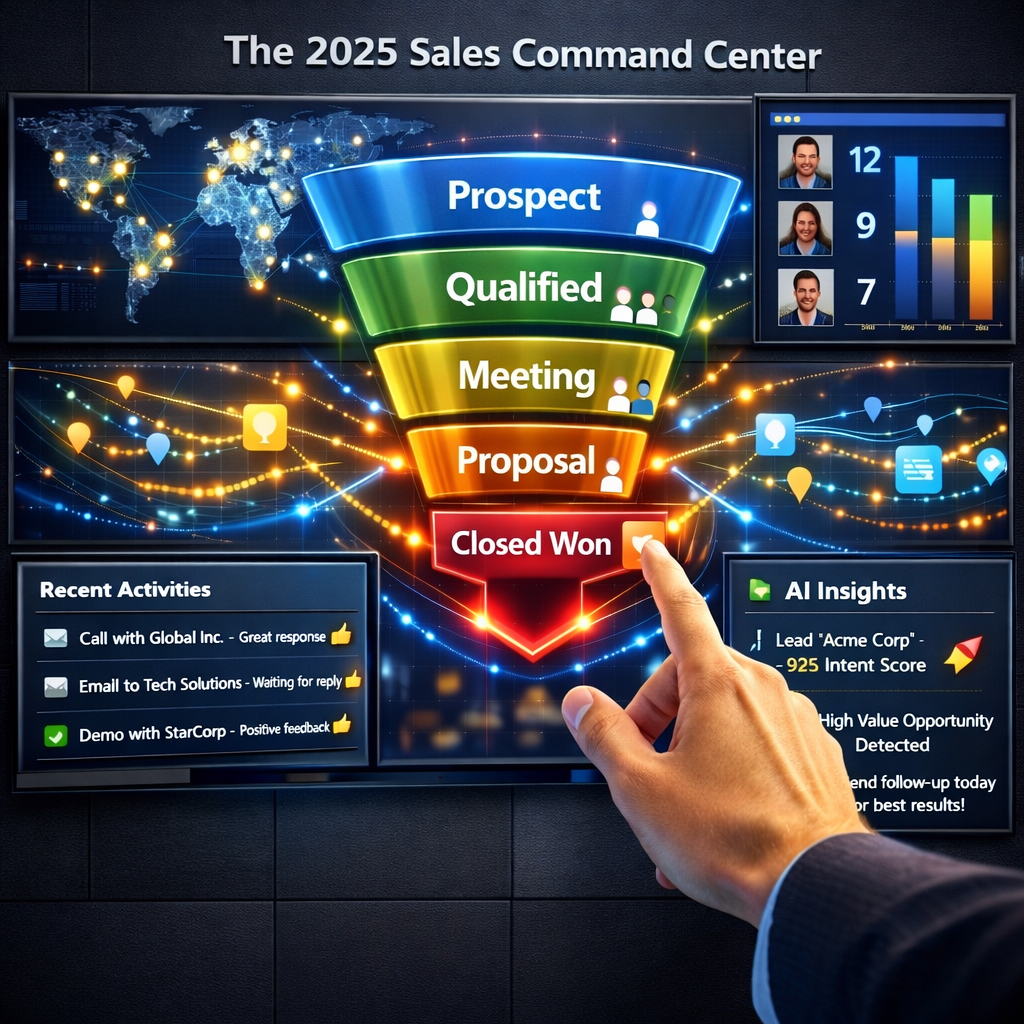
- Establish Your Insight Command Center: Build one primary dashboard in your CRM or BI tool that shows: Predictive Pipeline Value, At Risk Deal Alerts, and AI Generated Activity Insights. Make this the team's daily home screen.
The Human Element: Governing the Autonomous Stack
As AI takes on more execution, the human role shifts from operator to strategist and governor.
Adoption & Culture Strategy for 2025:
- Frame AI as the Junior Associate: Position AI tools as handling the "legwork" and "first drafts," freeing senior reps for high value negotiation and relationship building.
- Focus on Prompt Engineering Skills: Training now includes how to effectively "prompt" AI tools (e.g., writing instructions for email generation) to get the best output.
- Audit and Refine: Institute a monthly "AI Audit" meeting to review automated workflows, assess AI generated content quality, and adjust prompts and parameters. Trust, but verify.
Cost Considerations in 2025: Investing in Intelligence
The AI premium is real, but the ROI is clearer.
- Value Based Pricing: More tools are moving to value based or usage based pricing tied to outcomes like meetings booked or pipeline generated.
- Consolidate to Core Platforms: The trend is toward buying a core platform (CRM, Outreach Platform) with extensive AI capabilities and using its marketplace for integrated niche apps, reducing point solution sprawl.
- Calculate Intelligence ROI: Track metrics like "Time to First Draft," "Predictive Forecast Accuracy," and "Deal Cycle Compression" to justify AI tool costs.
The Horizon: The Self Driving Revenue Engine
The stack of late 2025 and beyond will trend toward full autonomy for routine processes. We are moving toward a "self driving" mode for lead qualification, initial outreach, and meeting scheduling, with humans stepping in for complex negotiation and strategic conversation. The winning small team stack will be characterized by:
- Closed Loop Learning: Every outcome (win/loss) is fed back into the AI models, making them smarter for your specific business.
- Agent Based AI: Multiple specialized AI "agents" (for research, outreach, scheduling) will work together under a central orchestrator.
- Frictionless Human AI Handoff: The transition from AI handled tasks to human intervention will become seamless and context rich.
Conclusion: Your Stack as Your Strategic Nervous System
For the small sales team in 2025, a modern stack is your strategic nervous system. It is the infrastructure that allows you to sense market opportunities faster, execute with personalized precision at scale, and forecast with confidence. In 2025, the competitive moat is built not just on having connected tools, but on possessing a learning, predictive system that gets smarter with every interaction.
By building on an AI native foundation, integrating predictive intelligence, and automating execution with clear human oversight, you empower your small team to act with the speed, insight, and scale of a tech powered giant. The goal is no longer just efficiency; it is augmented intelligence. Begin by activating the AI already in your core tools, integrate one predictive data source, and build a single autonomous workflow. In the AI augmented era, the small, agile, and intelligent team holds a decisive advantage.


