The New Era of Outbound: How AI Is Transforming Cold Email Into a Predictable Growth Channel
Cold email has always had a reputation problem.
Some see it as spam. Others see it as outdated. Many businesses try it once, get poor results, and decide it does not work.
The truth is different.
Cold email is still one of the highest return growth channels in B2B and high ticket services. What has changed is the level of precision required. The market is noisier. Buyers are more selective. Attention is harder to earn.
The companies that win with outbound today do not send more emails. They send smarter emails. They follow up consistently. They test constantly. They respond instantly. And increasingly, they rely on AI to do it.
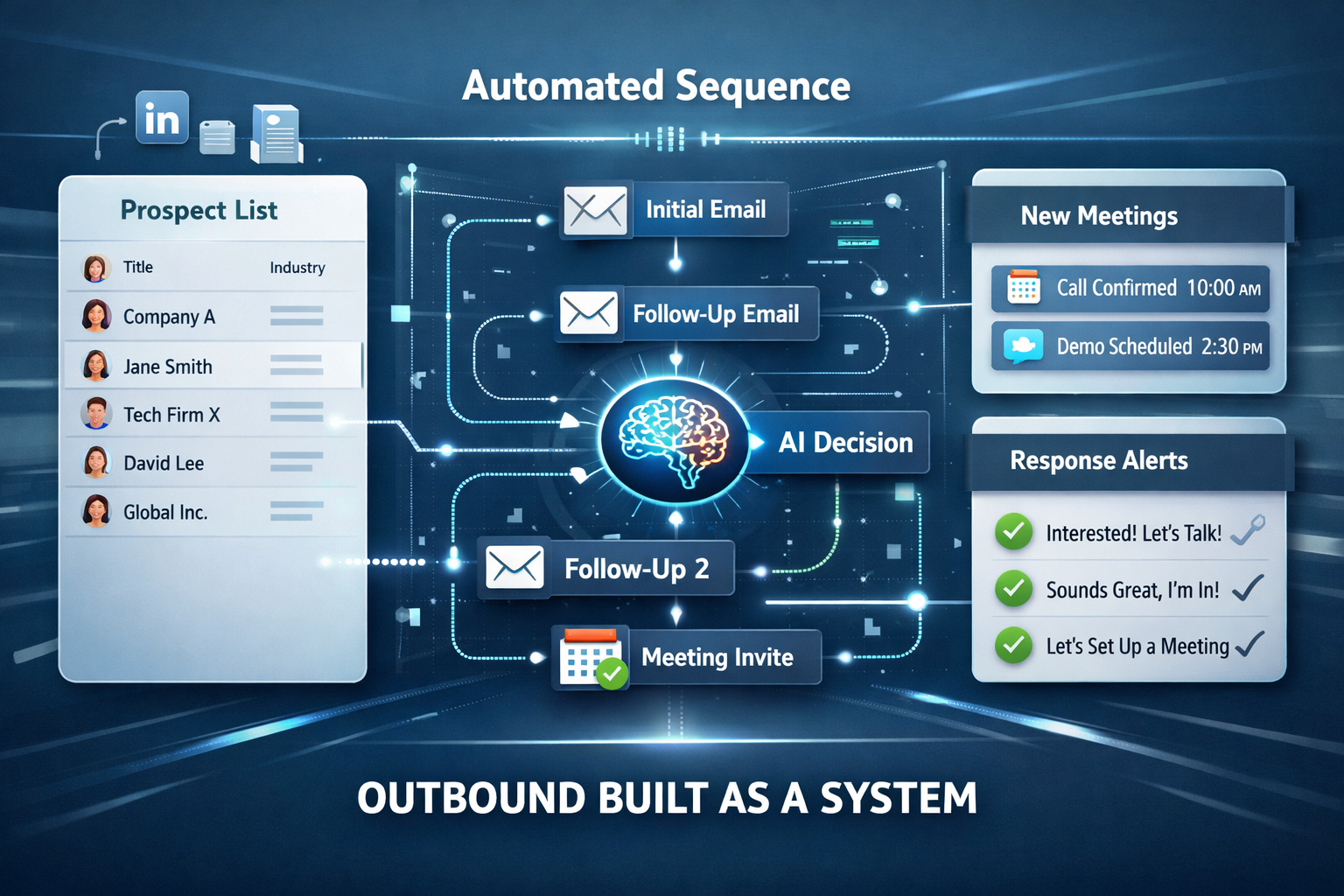
AI powered outbound lead generation is not about blasting thousands of messages. It is about building a system that finds the right prospects, sends relevant messaging, adapts based on behavior, and turns conversations into booked meetings at scale.
This is what modern outbound looks like.
Why Traditional Cold Email Fails
Most failed cold email campaigns share the same problems.
The targeting is broad.
The messaging is generic.
The follow up is inconsistent.
The testing is minimal.
The process depends heavily on manual effort.
A founder writes a few email templates, uploads a list, sends a campaign, and waits. A few replies come in. Most do not. After two or three weeks, the campaign is labeled ineffective.
What actually failed was not cold email. It was the lack of system.
Outbound only works when it operates as a structured engine, not as a one time experiment.
Outbound Is a Data Game, Not a Volume Game
Many teams assume success comes from sending more emails. That approach worked ten years ago. It does not work now.
Modern inboxes filter aggressively. Prospects recognize low effort messaging immediately. Relevance is everything.
AI changes the equation because it allows you to work with precision at scale.
Instead of guessing who might be interested, AI systems analyze data points such as:
Industry
Company size
Role
Technology stack
Recent activity
Hiring trends
Growth signals
This creates highly targeted prospect lists built around real buying signals rather than assumptions.
Better inputs lead to better outputs.
Personalization Without Manual Work
Personalization is no longer optional. It is expected.
However, true personalization is difficult to execute manually at scale. Writing hundreds of custom emails each week is not sustainable.
AI solves this by generating dynamic messaging based on prospect data.
Instead of sending the same template to everyone, the system can tailor introductions based on company information, recent announcements, pain points common to that role, or specific market conditions.
The result feels relevant without requiring hours of manual research.
Personalization increases open rates. Relevance increases replies. Conversations create revenue.
Intelligent Follow Up Is Where the Money Is Made
Most conversions do not happen on the first email.
They happen on the second, third, or even fifth follow up.
Yet many businesses stop after one or two attempts because manual follow up is exhausting and easy to forget.
AI powered outbound systems never forget.
They automatically schedule follow ups based on behavior. If a prospect opens but does not reply, the messaging can adjust. If there is no engagement, the tone can shift. If a reply shows interest, the system can escalate immediately.
Consistent follow up often doubles or triples reply rates compared to single touch campaigns.
The difference between an average outbound campaign and a high performing one is rarely the first message. It is the follow up structure.
Deliverability Is Strategy, Not Luck
Another reason cold email campaigns fail is poor deliverability.
If emails do not reach the inbox, nothing else matters.
AI driven outbound systems manage deliverability carefully. They warm domains gradually, rotate inboxes, monitor sending volume, and adjust based on engagement metrics.
They track bounce rates, spam complaints, and open behavior continuously.
Instead of guessing why a campaign slowed down, the system identifies the issue and adapts.
Deliverability is not a technical detail. It is the foundation of the entire outbound engine.
Turning Replies Into Booked Meetings Automatically
Getting replies is only half the battle.
The next step is converting those replies into scheduled conversations.
AI powered systems can classify replies automatically. Positive responses are flagged immediately. Neutral responses can trigger clarification messages. Objections can receive structured answers. Uninterested replies are removed from sequences instantly.
This reduces the burden on sales teams and shortens response time dramatically.
Speed matters here as well. When someone replies positively, responding within minutes increases booking rates significantly.
AI ensures no opportunity sits unanswered in an inbox.
Outbound as a Predictable Pipeline Builder
The biggest misconception about cold email is that it is unpredictable.
In reality, outbound becomes predictable when treated like a performance channel.
You track:
Number of contacts added per week
Open rates
Reply rates
Positive response rates
Meetings booked
Show rates
Close rates
When you understand these metrics, you can model pipeline growth.
For example, if one thousand targeted contacts generate fifty replies, ten meetings, and two closed deals, you can scale inputs strategically.
AI helps maintain consistency in each step, which stabilizes outputs.
This transforms outbound from a gamble into a controllable growth lever.
Continuous Testing Without Manual Overhead
High performing outbound campaigns are never static.
Subject lines evolve. Messaging angles shift. Calls to action change. Target segments expand or narrow.
Manual testing requires significant time and coordination. AI systems can run controlled variations automatically, measure performance, and prioritize winning versions.
Over time, this compounds.
Small improvements in open rates and reply rates create exponential improvements in booked meetings.
Optimization is not a one time event. It is an ongoing process.
AI makes that process sustainable.
Why Outbound Works Especially Well for B2B and High Ticket Offers
Outbound shines in environments where:
The target audience is specific
The deal value is significant
The buying process involves conversation
Decision makers are reachable by email
B2B services, SaaS platforms, consulting firms, agencies, and enterprise solutions all benefit from proactive outreach.
Inbound marketing relies on prospects searching. Outbound allows you to initiate conversations with companies that fit your ideal customer profile even if they are not actively searching yet.
This creates opportunity where none existed before.
Combining Human Strategy With AI Execution
The strongest outbound systems are not fully automated black boxes.
They combine human strategy with AI execution.
Humans define the ideal customer profile.
Humans craft positioning and core messaging.
AI executes outreach, follow up, and optimization.
Humans handle deeper sales conversations.
This hybrid model balances efficiency with authenticity.
AI handles repetition. Humans handle persuasion.
Together, they create a scalable engine.
Avoiding the Spam Trap
There is a difference between structured outbound and spam.
Spam is mass messaging without targeting or relevance.
Structured outbound is targeted, value driven, and respectful.
AI systems actually reduce spam behavior because they focus on precision rather than volume. They filter prospects carefully, personalize messaging, and stop sequences when signals indicate disinterest.
Reputation improves when outreach is thoughtful.
The goal is not to flood inboxes. The goal is to start relevant conversations.
From Campaigns to Infrastructure
Many companies treat outbound as a temporary campaign.
Modern growth teams treat it as infrastructure.
Infrastructure means:
Always on prospecting
Consistent weekly list building
Ongoing testing
Structured follow up
Clear performance tracking
AI makes this sustainable without overwhelming internal teams.
When outbound becomes infrastructure, pipeline becomes consistent.
What Happens When Outbound Is Done Correctly
When AI powered outbound is executed correctly, several things happen.
Sales teams spend more time closing and less time prospecting.
Calendars fill with qualified conversations.
Revenue forecasting becomes easier.
Growth becomes proactive instead of reactive.
The business is no longer waiting for leads to come in. It is creating them intentionally.
This shift changes the entire growth mindset of a company.
The Competitive Advantage of Acting Early
AI powered outbound is still underutilized in many industries.
Companies that implement structured systems now gain a significant advantage. They build relationships before competitors. They dominate inbox share. They gather data that improves targeting over time.
Early movers benefit from lower competition and higher response rates.
As more companies adopt AI driven outreach, the standard will rise. Acting early compounds results.
The Future of Cold Email
Cold email is not disappearing. It is evolving.
The future belongs to:
Highly targeted prospecting
Dynamic personalization
Intelligent follow up
Automated classification
Continuous optimization
AI makes all of this possible without scaling headcount at the same rate as outreach volume.
Outbound is no longer about hustle alone. It is about structure, systems, and intelligent execution.
Companies that embrace this shift are building reliable, scalable growth engines.
Those that ignore it will struggle with inconsistent pipeline and rising acquisition costs.


